Showing posts with label macroeconomics. Show all posts

Friday, June 10, 2011

A fascinating looking paper

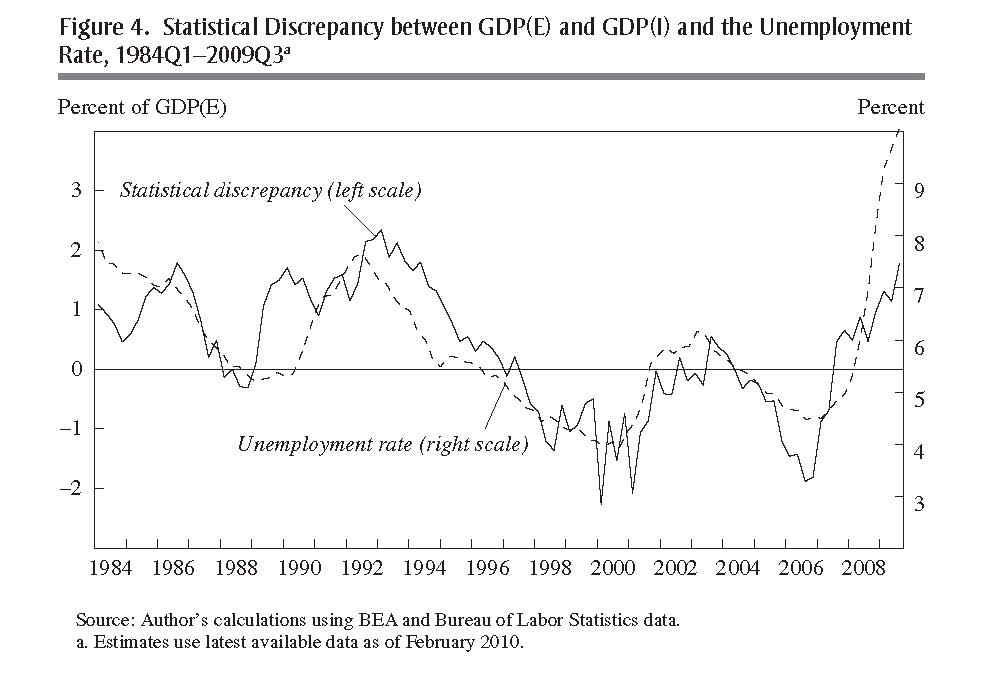
Arnold Kling points us to Justin Wolfers who shares a new Brookings Paper on Economic Activity from Jeremy Nailewaik that I'm finding fascinating. Nailewaik is discussing two different measures of GDP -one based on expenditures and one based on income, which presumably should be equal. Kling and Wolfers focus on a timing question - Nailewaik suggests the income based measure is more accurate, and that measure shows the recession started earlier than our usual expenditure based measure.

I'm interested in something somewhat different. So from the Keynesian perspective statements like "an income based measure of output and an expenditure based measure of output should be equal" needs a little more elaboration, because the Keynesian point is precisely that it's the process that makes these two equal that is so essential to understanding the business cycle.

So what is a business cycle? The most fundamental description is that it's when expenditure is "trying to be lower" than income, and income is adjusting dynamically. There are a couple different processes to look at when we talk about the dynamic adjustment: (1.) consumption behavior and the multiplier, (2.) money demand, interest rates and investment demand, etc. But that's the story in a nutshell.

UPDATE: I read the graph wrong - read the comments below for details and for some thoughts on what is going on. Bob Murphy talks about it here too. Any other ideas?

So what would we expect to see? Well, we wouldn't expect discrepancies between income and expenditure measures of output to be random, for one thing. We would expect these discrepancies to have pronounced cyclical qualities. Particularly, when the income measure is high relative to the expenditure measure (when more income is being earned than is being spent) we'd expect to see more unemployment, and when the income measure is low relative to the expenditure measure, we'd expect to see less unemployment.

Which brings us to figure four in the Nailewaik paper (page 88). Now that is a fantastic graphic:

Wednesday, May 4, 2011

More Nick Rowe on Monetary Disequilibrium

Still getting my head around it, but there are a couple points he does a good job detailing things that I've asked him about in the comment section here.

Nick says he's heavily influenced by Patinkin - I was leafing through my copy of Money, Interest, and Prices this morning and I decided I'm going to have to read this soon. This is one of several classic texts I was able to pick up for free when they shut down our library at the Urban Institute and let us scavange the shelves.

Enjoy.

"We're all Pigovians Now"

That's probably what Friedman should have said. Surprisingly, I actually agree with a lot that Casey Mulligan has to say in this post.

Anyone that doubts what Mulligan is saying here needs to answer the question of why prices have been consistently eight points higher than we estimate they should be for over two years. "Sticky prices" doesn't give you a two year delay in price adjustment. Zero lower bound stuff is useful for talking about what policy can and can't accomplish but even that's inadequate here: not ever price is at a zero lower bound, after all. Some institutional explanations - "disrupted credit channels" - admittedly might play some role. But this issue that Mulligan points out is not trivial. We need to be in search of explanations which present a situation where we would not expect the market to right itself - even after two years.

UPDATE: Paul Krugman is much less sympathetic. Krugman, of course, is New Keynesian born-and-bred, so it's not surprising that he points out the nuances of New Keynesianism and the simplification that Mulligan provides. This is fair to a certain extent. The zero lower bound that Krugman mentions has been incorporated in some New Keynesian work. You've got things like the old Kenyesian IS and LM material which is reincarnated in an IS-MP model, or re-derived from microeconomic frictions, etc. New Keynesianism isn't simply "stick prices did it" economics, as Mulligan presents. But price rigidity is featured very prominently, and Krugman himself has demanded that the discipline be reinvigorated with some old Keynesianism insights. My point on Mulligan was this: he's right that anyone relying largely on price rigidities should be seriously reconsidering things right now. Krugman is probably right as well that Mulligan has dumbed down New Keynesianism.

Saturday, April 30, 2011

Nick Rowe, Brad DeLong, and Me on Whack-A-Mole General Gluts and Money

The other day I took some issue with the idea that general gluts are just excess demand for [bonds, money, secure assets] and excess supply of goods and services. The idea isn't absurd, of course. If there happens to be no excess demand for money but there is an excess demand for bonds and surplus of goods and services, that will sure feel like a recession to workers and look like a recession in the data. In that sense I don't think Brad DeLong's version of the story is wrong per se. In all likelihood we've had many downturns characterized by this sort of general glut. But there's something ultimately unsatisfying about this approach when you're going through a downturn that just doesn't bounce back - when you have a stable underemployment equilibrium. Why would this "whack-a-mole" general glut not work itself out? Brad provides several great reasons why not: disrupted credit channels, the zero lower bound, etc. All of these reasons are very good reasons for why a whack-a-mole general glut would lock in for a while. And perhaps that's all there is to it.

But I have my doubts that that's all there is to it, and so does Nick Rowe. However, Nick takes a somewhat different approach from me an in a lot of ways, my approach to why the whack-a-mole theory is incomplete is closer to Brad.

Nick starts with a review of some quantity-constraint material which is very good to look over. He was the one that first alerted me to how important Janos Kornai's work on socialist economies was for understanding market economies - because of these quantity constraints (supply constrained under socialism, demand constrained under the market).

Then Nick gets into the monetary stuff:

"If there are n goods, including one called "money", we do not have one big market where all n goods are traded with n excess demands whose values must sum to zero. We might call that good "money", but it wouldn't be money. It might be the medium of account, with a price set at one; but it is not the medium of exchange. All goods are means of payment in a world where all goods can be traded against all goods in one big centralised market. You can pay for anything with anything. In a monetary exchange economy, with n goods including money, there are n-1 markets. In each of those markets, there are two goods traded. Money is traded against one of the non-money goods. Each market has two excess demands. The value of the excess demand (supply) for the non-money good must equal the excess supply (demand) for money in that market. That's true for each individual (assuming no fat fingers) and must be true when we sum across individuals in a particular market. Summing across all n-1 markets, the sum of the values of the n-1 excess supplies of the non-money goods must equal the sum of the n-1 excess demands for money.

Walras' Law describes an economy with one market with n goods traded and n excess demands. In a monetary exchange economy there are n-1 markets with 2 goods traded and 2(n-1) excess demands.

OK. So can't we just re-state Walras' Law as saying that the sum of the values of the excess supplies (demands) for the n-1 non-money goods must equal the sum of the n-1 excess demands (supplies) for money?

The short answer is: "No, you can't". Or rather: "You can if you like, but it's a very different beast from the original Walras' Law, and is totally useless"."

I like to think in terms of a linear system, because when we worry about recessions we're worrying about slack, and with a linear system it's very easy to conceptualize exactly what the source of the slack is. So Nick talks about n-1 markets and n goods (one being money, which crucially has no market, and is instead traded in all markets). When he says "market" think of a linear system with a supply and demand schedule. So:

Qs=a+bP
Qd=c-dP

Putting this in equilibrium (Qs=Qd) and moving things around:

Q-bP=a
Q+dP=c

...and the solution is trivial. That system is a "market". There are n-1 goods out there and then Nick adds money which makes "n", but he says money isn't traded in a market, so that's n goods, n-1 prices, and 2(n-1) market relations (because you have a supply relation and a demand relation for each market). I think Nick is wrong here. Why? Let's go back to our system of equations - "money" gets a column because it's a good, right? Does it get a row? Nick implies no - because there are n-1 markets. But this seems wrong. It oughta get a vector of prices, right? That's what the "price level" is, after all - it's the inverse of the value of money. So while Nick tells us there are n-1 markets which have 2(n-1) market relations and n goods, and n-1 prices it seems to me there are n goods, n-1 prices, and the price level.

This, I think, is what Brad was thinking in this post where he took issue with my claim that the nature of the interest rate as one price operating in two markets implied an overidentification. Brad wrote: "In the language that Dan is talking, I think that the right thing to say is that if the price level is sticky then the Walrasian system is over-identified. If the price level is flexible then the Walrasian system is just identified--the thing that is supposed to move in order to eliminate the excess demand for financial assets is the price level, and it does not, or it does not move fast enough."

This thinking from Brad seems very close to what Nick is saying to me: n goods (including money), n-1 markets, and one "price level" producing a perfectly identified system. In this system, you need sticky prices to get slack, Brad is right on that.

But the problem is, we don't live in this system. And you know who drove this home for me? Brad DeLong.

Everything comes down to money and the interest rate, and everything comes back to Keynes. In this post, Brad explains why the interest rate is really one price functioning in two markets: the bond market and the money market. People want loanable funds and people want liquidity. Let's bring this back to our system of linear equations where Brad is an out-of-the-closet Walrasian (who is open about the fact that the price level squares the system of linear equations) and Nick is a still-in-the-closet Walrasian (who still insists we have n goods and n-1 markets even though it's clear that that n-th good - money - is related to all the other goods through the price level). What does the interest rate do to this system of equations?

It overidentifies the system, introducing the very real potential for slack. Before we had n-1 goods, n-1 prices, and money for a total of 2(n-1)+1 columns. We had 2(n-1) market relations (supply and demand in each of the n-1 markets) and the price level for a total of 2(n-1)+1 rows. This is a well-identified system where we can have whack-a-mole general gluts but no reason to think those gluts won't be arbitraged away eventually (by adjustments in the price level, a la Brad's point, if nothing else). But Keynes points out that we are missing one row - one market relation. We are missing the money market or the market for liquidity - that market that Nick says doesn't exist. This is the liquidity preference theory of the interest rate - the interest rate is determined by the desire to stay liquid. The problem is that while we add this market relation as a row in our linear system, we don't add another column so that the system remains identified. Why? Because we already have the interest rate as a column - because the interest rate is the inverse of the price of bonds (which are presumably already there as one of our n-1 goods and n-1 prices).

This is a major problem. Now we have 2n rows and 2(n-1)+1 columns. That introduces slack. Now, where that slack shows up isn't entirely clear. Keynes said investment was made based on the investment level that would equalize the marginal efficiency of capital and the interest rate. So he thought a lot of the slack would show up in investment. It's not a bad approach - we do see the sharpest drops during recessions in investment. Keynes was a sharp guy. Hicks took a slightly different approach that was perhaps better suited to the new wave of national accounts measurement. In his model, he forced the loanable funds market to actually clear at the same interest rate as the money market. This means no slack in the loanable funds market, so the slack would be felt in the prices or quantities of goods and services. Hicks strikes me as being a little more presumptuous than Keynes in this respect, so I somewhat prefer Keynes - who left the question open.

Anyway - hopefully this clarifies where I agree and where I differ with Brad and Nick. I think Nick's system is relatively Walrasian once you think about the role of the price level. I think Brad's unashamedly Walrasian system ignores his own prior writing about the interest rate. And I think the interest rate is key: it is one price operating in two markets. You can arbitrage your way out of whack-a-mole gluts. You cannot arbitrage your way out of an overdetermined system. You have to hack the system - you have to get the interest rate to a level that is consistent with full employment.

UPDATE: And this, I should add, is why despite Brad's quite justifiable praise of Say, Bastiat, Mill, Bagehot, Fisher, and Friedman - there is a very good reason why Skidelsky calls Keynes "the master", and why I write so much about him on here.


*****

The blogosphere can get heated when people disagree with each other. Let me nip that in the bud. Nick and Brad are quite simply the best bloggers that I follow right now. Most of this stuff I ultimately, at some point picked up from them anyway!

Friday, April 15, 2011

New Acquisition


I just ordered Rob Shimer's Labor Markets and Business Cycles (2010), and I may be reading it next (it might turn out a semester back in the swing of graduate level economics would help me digest it better, though). I expect Shimer's work to be a jumping off point for my dissertation, particularly the material on wage rigidity. Wage rigidity does not play a big role in my view of macroeconomic fluctuations, but (1.) maybe it should - particularly for the more typical downturns which I'm likely to see more of in my lifetime than more atypical downturn that we're going through now, (2.) even if I stay unconvinced of the importance of wage rigidity, I ought to work on it because this is a quite dominant perspective in the field right now. This may take me into using the sexy LEHD data that everybody loves but I'm concerned that (because it only provides earnings and not wage rates), the plain Jane CPS might end up being more useful for me. Anyway - I have a rough brain storm of the types of ideas I might look into, and reading and familiarizing myself with this book seems like an important start.


Thursday, April 7, 2011

The problem of micro-imperialism in economics

A couple days ago, in this blog post, I asked which of three labor markets were in a recession. My answer is - "I don't know, I don't have enough information". Hopefully, this revised figure helps explain why (assume, as the last piece of information, that every one of these economies has 15 people in it):

We have been trained to think that "unemployment" means "labor surplus". It doesn't. "Unemployment" means "the amount of people who want to work that aren't working". That is not the surplus gap between labor supply and labor demand. That is, in micro-speak, every point on the labor supply curve to the upper right of the labor market equilibrium. They don't know that their reservation wage is above equilibrium, and even if they did know that, since when has having your wage above the market equilibrium disqualified you from being considered "unemployed"? This is one of many examples of the intellectual imperialism of microeconomics in economics. Labor surpluses have nothing to do with unemployment or recessions - employment levels do. Labor surpluses tell you something about the likely behavior of wages and employment in the future, and perhaps about social welfare. There's nothing about labor surpluses that is of necessity relevant to the business cycle.

One of the problems with the way macroeconomics is thought about and done is that people have taken "understanding the business cycle" to mean "understanding what causes labor surpluses". This leads them down the path of sticky wages or minimum wages. These things may indeed influence the business cycle, but that is not automatically implied by the fact that they create a microeconomic labor surpluses. Which economy would you rather live in? I'd rather live in an economy with higher welfare, higher dead-weight loss, and higher employment, than in an economy with lower welfare, lower dead-weight loss, and lower employment.

This mentality has even creeped its way into where it shouldn't: Keynesian macroeconomics. Ryan Murphy has a further discussion of my 1920-21 paper and one of the things he says is: "Keynes believed that full employment is the special case, but Keynes didn’t develop IS-LM. One of the most surprising developments in the development of IS-LM was that its “general” case WAS full employment, and it took special things to get you to unemployment. This is really where I fundamentally disagree with Kuehn." He then links to the New School for Social Research's history of thought website which also claims that the Neoclassical Synthesis version of the IS-LM "tended to yield the Neoclassical result of "full employment"". I realize I am going somewhat out on a limb by criticizing the team at the New School on this, but I think it's the wrong interpretation of the model. The IS-LM model tends to microeconomic labor market clearing. That is quite different from saying that it tends to full employment.

I don't think much of "microfoundations", at least as any kind of theoretical obligation. Clearly if we can produce a correspondence between microeconomics and macroeconomics, that's fantastic. But "macrofoundations" are just as important. Even someone interested in "microfoundations" shouldn't pursue that by trying to superimpose microeconomic concepts onto macroeconomic concepts inappropriately. "Labor surplus" has to do with (1.) welfare/efficiency questions, (2.) questions about equilibrating tendencies, and (3.) match efficiency questions (because there is a pool of workers ready to work at a given wage). It has nothing directly to do with the problem of unemployment (although certainly point (3.) in that list will indirectly impact unemployment).

UPDATE: Another good way to think about the microfoundation obsession in economics is to look at other sciences. In physics, for example, we don't say "relativity is inadequate because it isn't derived from particle physics". The search for a unified theory of physics isn't a search to reproduce relativity from particle physics - it's an effort to find a consistency between relativity and particle physics, so physicists don't have to say "we know relativity is true and we know particle physics is true, and we can talk about both of them but we don't know a good unified way of talking about how they're both true". That should be how economics should approach the question. We oughta explore a lot of macrofoundations of microeconomics, a lot of microfoundations of macroeconomics, and also simply some new ideas. In the meantime, it's silly to consider some ideas tentative because we haven't hit on a correspondence. So why do we obsess over microfoundations? I think it's because microeconomics happens at the individual level, so our brains privilege that and assume any knowledge of what happens at the individual level necessarily has a sort of priority over other knowledge. You don't have this in physics because neither particle physics nor relativity happen at "our level". You did have this in biology for a while - it took a lot of pushing to get biologists to stop thinking about the selection of specific organisms and instead think of selection of what was actually being reproduced: genes. We have a bias towards that which we know best: ourselves. That cognitive bias can lead to bad economics if it generates an obsession with microfoundations.

Wednesday, April 6, 2011

Why is the Heritage Forecast of the Ryan Plan so Rosy: Two Thoughts

A lot of people are talking about the implications of Paul Ryan's budget plan for Medicare or for the deficit, but something else has caught my eye: the economic forecasts that Ryan trumpets his plan will bring about. Ryan Avent, Brad DeLong, and Matt Yglesias all point out that they are wildly optimistic. How optimistic? Well, Paul Krugman notes that Ryan is claiming he will achieve unemployment rates so low that we haven't seen them since the early 1950s!! Wow!!

So where did these estimates come from? The Heritage Foundation, of course.

This is the Heritage Foundation's analysis of the Ryan Plan. The Heritage Foundation has been quick to point out that they are using the IHS Global Insight (a mainstream forecasting firm) macroeconomic model to make these forecasts. I'll come back to that later. My first reaction was "how did that model get these results?", so I took a look at their methodology and the answer was fairly obvious: the Heritage Foundation put its thumb on the scales. There are two things I noticed: the labor supply elasticity (which I am a little less clear on and would need some clarification), and the impact on private investment.

1. Labor Supply Elasticity (update below): Economists have known for a long time that if you look at how responsive an individual worker is to a change in income and how responsive an aggregate labor market is to a change in income, you get a different result; the aggregate "elasticities" are higher. Something fishy is going on with the labor supply elasticities in the Heritage model. They write: "Taxes on labor affect labor-market incentives. Aggregate labor elasticity is a measure of the response of aggregate hours to changes in the after-tax wage rate. These are larger than estimated micro-labor elasticities because they involve not only the intensive margin (more or fewer hours), but also, and even more so, the extensive margin (expanding the labor force). The change in the labor supply variables were adjusted by the macro-labor elasticity of two, which is a middle estimate of the ranges. The adjustment to the add factors allowed the variable to continue to be affected both positively and negatively by other indirect effects." So there's nothing wrong with this logic and there's nothing wrong that I'm aware of with a macro-elasticity of two. What concerns me is the bolded section. What "change in the labor supply variables" are they refering to? I think they're refering to the labor supply response from the microsimulation that they reference earlier. I looked through the CBO's simulation of labor supply and they seem to only do a microsimulation, which is then put into a macro model. So it looks like (although I'm not clear on this), Heritage's microsimulation estimates a labor supply response and then they have an "add factor" (an adjustment, essentially) in the macrosimulation to make labor supply respond again using a macro elasticity. I'm just suspicious because (1.) the CBO, which usest he same sort of IHS Global Insight model, doesn't seem to simulate labor supply at the macro level, and (2.) double-counting a labor supply effect would be exactly the sort of thing that would get you unemployment rates so low that we haven't seen them in over half a century.

UPDATE: This labor supply elasticity issue may be related to the dynamic scoring question discussed by Ezra Klein. My personal view is that there's nothing wrong with dynamic scoring - indeed it's a good idea - but it offers the opportunity for puting in a lot of assumptions that help your case. I'm not entirely sure the apparent use of both micro and macro labor elasticities is the same thing as dynamic scoring, though. Dynamic scoring is supposed to impact feedback effects that influence revenue estimates ("tax cuts pay for themselves" type stuff). Since you're looking at aggregated revenue, you're going to want to use a macro-elasticity to predict feedback effects influencing revenue. I'm still not sure if that means that labor supply itself should react twice to tax changes (once in the microsimulation and again in the macrosimulation) as the Heritage methodology seems to suggest it does. In other words - this might make sense for the revenue estimates, but it may still be overly optimistic about the labor force estimates. I'm crossing the above section out since I'm not sure - hopefully people can still read it and provide their own insights.

2. Private Investment: This one should be old hat by now. The Heritage Foundation writes: "Economic studies repeatedly find that government debt crowds-out private investment although the degree to which it does so can be debated. The structure of the model does not allow for this direct feedback between government spending and private investment variables. Therefore, the add factors on private investment variables were also adjusted to reflect percentage changes in publicly held debt. This can also put upward pressure on the cost of capital (thus helping the model balance the demand and supply effects on the cost of capital)." Yes, government debt crowds out private investment when we're at full employment. I will poll readers on this: do we appear to be at full employment? This is exactly the same assumption that gets theoretical results that say fiscal contraction is expansionary. Yes, if you assume away all the problems that economists are pointing to that we are dealing with right now, things look rosier. That's no surprise. It's also no help in providing an assessment of what to expect from the Ryan plan. Note that this is another "add factor". This is something that they went into an existing, tested, widely acknowledged model and said "I don't like that - I'll change that". These people aren't dumb - they knew exactly which change they were giving themselves when they made that adjustment.

Macro Model Controversies: One interesting thing about this Heritage forecast is that it uses an adjusted IHS Global Insights model, which is the same model that predicted that stimulus would be stimulative. This model, and others much like it, got a lot of criticism in the libertarian community, because the model results are essentially determined by the assumptions about how the macroeconomy would respond (things like the labor supply elasticity and the response of private investment). Russ Roberts called the IHS Global Insight model and models like it a "hoax" and "not meaningful" when it predicted a positive impact on the stimulus. His point was the same as mine, that they are dependent on the assumptions that we feed into them. Unlike me, though, he thinks this makes them illegitimate. I think they're perfectly legitimate as a statement of the implications of our theory - we just need to know the assumptions that underly them and dispute or promote those assumptions. When IHS Global Insight, CBO, Macroeconomic Advisors, and Moody's Economy.com came out with their positive assessment of the stimulus, Russ wrote a post called "The Great Stimulus Hoax" criticizing them and suggesting that these sorts of models aren't meaningful. If Russ had any consistency at all, I'd like to see him write a post today called "The Great Austerity Hoax", providing essentially the same critique of the Ryan plan analysis which was done using the same methods.

I'm not holding my breath on that one. Cafe Hayek is a quite political blog, and on top of that a graduate from the George Mason University economics department and a former president of the Institute for Humane Studies at George Mason University were both authors of the Heritage report.

Wednesday, March 2, 2011

Mulligan on the Stimulus

Can anyone provide me with a stimulus critic that actually tries to grapple with endogeneity issues when they look at the data?

I know it's just a blog post, but Casey Mulligan has a post up today that just looks at the raw data. His version of a counter-factual is to assume economic projections early in the downturn were right (hmmm...). He's not alone. John Taylor regulalry dumps some BEA numbers into excel and calls it a day. In a recent working paper by Cogan and Taylor, their counterfactual is that most of the stimulus spending to states went to reduce borrowing, and that purchases would not have changed at all in the absence of the stimulus (see page 13 and 14). Guess what - when you assume a "no effect" multiplier when designing your counter-factuals, you end up getting no effect in your results. Shocking! This is Stanford University and the University of Chicago being represented here.

I would be more open to these positions if any of these guys made any effort at all to even acknowledge the endogeneity problems and tried to objectively deal with them, rather than assuming their own conclusions and passing it off as economic science. I can think of one stimulus skeptic who has done this: Robert Barro. And he has a very interesting identification strategy. I like to highlight Barro's work whenever I criticize others' work because he actually makes a good effort. My critique of Barro is not that he does something wrong, but that his findings aren't generalizable. When you estimate multipliers outside of depressionary conditions you can't claim to have an estimate of what the multiplier would be in a depression. We expect it to change. But Barro provides good evidence that government spending crowds out private spending in normal times.

Anyway - just frustrating to see Mulligan this morning. These guys essentially assume their conclusions and a lot of people still take these to be reasonable claims.

Friday, February 25, 2011

IV estimate of fiscal multipliers

I'm usually skeptical of instrumental variable models, but this seems more convincing. I'd have to look closer at it, but I imagine this isn't some tiny independent variation they're trying to hang a result on. I'm guessing Congressional seniority and the number of representatives per person has a big effect on spending decisions (and not much effect on economic performance).

The results pretty much predict what I would expect. This is the abstract:

"We use state and county level variation to examine the impact of the American Recovery and Reinvestment Act on employment. A cross state analysis suggests that one additional job was created by each $170,000 in stimulus spending. Time series analysis at the state level suggests a smaller response with a per job cost of about $400,000. These results imply Keynesian multipliers between 0.5 and 1.0, somewhat lower than those assumed by the administration. However, the overall results mask considerable variation for different types of spending. Grants to states for education do not appear to have created any additional jobs. Support programs for low income households and infrastructure spending are found to be highly expansionary. Estimates excluding education spending suggest fiscal policy multipliers of about 2.0 with per job cost of under $100,000."

Big multipliers on non-grant, non-education stuff, modest multipliers on the whole shebang. A couple thoughts:

1. Krugman notes that this is going to still underestimate multipliers because of spillover. If New Jersey stimulus boosts New York and New York stimulus boosts New Jersey this will cancel that out and miss the effect because the model is identified off the variation between states.

2. So the education multiplier was small, but this also seems like it would be the component of spending where the instrument is weakest. I don't know how the sausage-factory that is the Congress works on these things, but I would guess grants to states are likely to be far more formulaic (and therefore less correlated with Congressional seniority, and therefore biased downward in these IV estimates) than spending on other grants and projects. I'm guessing there's some kind of per-student or per-Medicaid beneficiary or per-dollar-state-budget-shortfall calculations that go into that. So while the low education multiplier isn't especially surprising compared to infrastructure spending, it may still be an underestimate.

3. This goes for support programs for low-income families as well, many of which are run through the states. These programs were already found to have high multipliers. If the disbursements were formulaic rather than based on politics, then the actual multiplier is likely to be even higher.

UPDATE: So for those not familiar with my typical unease with IV models, I should probably say why this is more convincing, otherwise it seems a little self-serving. This instrument does two things that a lot of instruments don't that makes me more confident in it. First - the causal relationship between Congressional representation/seniority and fund disbursements is very real and very clear. There's no subtlety to it - you can take this relationship to the bank. It's not like Angrist and Krueger's birth cohort schtick where you were taking a very, very subtle causal relationship and identifying a model off of it. This relationship is clear and there's no clear alternative channel through which this could be affecting state growth besides through federal spending that even comes close to the effect on spending. The second thing that encourages me about this is the expected direction of the bias. In studies on the returns to education, the endogeneous processes people worry about bias estimates upwards. So when you get a positive result from an IV model on those studies, you're always secretly wondering "is this a real positive effect or not?". In fiscal multiplier analyses, the endogenous process people worry about biases estimates downwards. Unlike returns to education studies, empirical multiplier estimates (not calibration of Keynesian models with various MPC estimates - but actual empirical studies like this) are always conservative estimates. When you get a positive result on one of these, you can be more confident in it (if anything it's an underestimate).

UPDATE 2: Scott Sumner does not agree on this paper. I think he's wrong on at least one point, but I think he makes an additional very interesting criticism of the paper that has some validity. One way to look at this (as Sumner does) is that it is a "micro study" because it is not a "national study". This isn't exactly right (what would constitute a "macro" study in the EU these days? A national study? An EU-wide study?). The difference between macro and micro is an aggregation of economic activity across all markets. It doesn't matter at what level that aggregation is - if you're discussing the behavior of aggregates, you're discussing macro. But it does raise some important questions. A lot of fiscal policy is supposed to operate through the bond market - and that is a national market (and thus it is differenced out in this analysis for the same reason that spillovers across state lines are). I'll try to post more on it this weekend, but if I don't that should give you a flavor of my thoughts on Sumner's critique.

Tuesday, December 14, 2010

Drinking microfoundations from a fire hose

- Peter Diamond's prize lecture
- Dale Mortensen's prize lecture
- Chris Pissarides's prize lecture

I have now listened with great interest to all of these, but my title was chosen for a reason - I have no idea how to distill it all for readers right now, and I think I'm going to listen to Pissarides's a second time. All very good - listen to them if you haven't already.

- Rajiv Sethi on microfoundations with lots of good links (HT Mark Thoma)

- David Andolfatto isn't really talking about microfoundations, and it's not really a fire hose... it's a strong garden hose that you realize somebody put a kink in... maybe that kink will eventually be released, and a gush of water will come out, but by the end of it I didn't get that much out of it. He starts of by accusing certain Keynesians of being naive and simple-minded, then he acts like he's going to put together some more sophisticated framework to demonstrate that, and then the framework he comes out with essentially ends up telling a Keynesian story. I link it here because the framework itself (which he links to) is more formal and sophisticated than a lot of blog posts you see, and formalism is always nice in this quite informal medium that we are all operating in. Still... the story sounds pretty Keynesian to me. And what he calls "rational pessimism" and "irrational pessmism" both sound Keynesian to me (he only calls it Keynesian if its "irrational pessimism", and that seems to be the sum total of his critique of Keynesian stories).

All this makes me think I need to read Phelps et al. as soon as this populism stuff is out of the way.

Thursday, December 2, 2010

Macroeconomics, Science, and Engineering

Robert Johnson and I have been discussing the extent to which economics is a science (or a "soft science") in the comment section of this post. The very term "soft science" is like nails on a chalk-board to me. I find it completely vacuous. I'll loudly proclaim that there are varying complexities of the systems that various scientists study and that this needs to be taken seriously - but this doesn't really speak to the scientific quality of that field of study. Social science is not the half-way point between the "sciences" and the "humanities". "Social science" is the name we give to certain sciences because our self-absorption and self-aggrandizement revolts against the idea of classifying economics as a sub-branch of primatology.

Anyway - I can't really comment much longer on that post, but at the end I was getting the sense that a lot of the difference between my views and Robert's views might be emerging from the fact that I separate questions of science, engineering, and forecasting. To me they are very different things. One is the pursuit of understanding through the scientific method. Another is the application of that understanding to problem solving. The third is the application of that understanding to piercing through the "dark forces of time and ignorance that envelope our future". All are noble pursuits. All are rightfully done by economists with varying degrees of success. All are quite distinct, though. I think we are quite good at economic science, and somewhat less good at economic engineering and forecasting (we are probably better at engineering and forecasting than meteorologists, worse at engineering but better at forecasting than geneticists, and worse at both engineering and forecasting than astronomers).

Anyway - all I intended to do here was to quickly point readers to an essay that Greg Mankiw wrote a while back on the macroeconomist as an engineer and the macroeconomist as a scientist. Here's a good selection from the beginning:

"To avoid any confusion, I should say at the outset that the story I tell is not one of good guys and bad guys. Neither scientists nor engineers have a claim to greater virtue. The story is also not one of deep thinkers and simple-minded plumbers. Science professors are typically no better at solving engineering problems than engineering professors are at solving scientific problems. In both fields, cutting-edge problems are hard problems, as well as intellectually challenging ones. Just as the world needs both scientists and engineers, it needs macroeconomists of both mindsets. But I believe that the discipline would advance more smoothly and fruitfully if macroeconomists always kept in mind that their field has a dual role."

Monday, November 29, 2010

The Practice of Macroeconomics - A Few Rules

There have been three good posts recently from Paul Krugman, Arnold Kling, and Steve Horwitz on how to do macroeconomics (or in Horwitz's case, Austrian economics in general). Krugman makes the point I often do that you can't assume that all macroeconomic episodes are created equal or that they should be responded to in the same way. It's a point that Jefferson and Keynes have both made emphatically, and one that Tom Woods and Bob Murphy would do well to digest. Arnold Kling makes several points on here about identification problems in macroeconomics. He also notes the relationship between model building and a person's macroeconomic priors. I think this is very important, and a good introduction to the way that empiricism can be used to pursue truth (and the ways in which it cannot). Steve Horwitz wrote a very thoughtful post with a lot of very thoughtful comments on what Austrian economics is - emphasizing for the most part the Peter Boettke's ten tenets of Austrian economics and Steve's own concerns about the tendancy to mesh positive and normative insights.

These all got me thinking more concretely about a few thoughts/rules of my own on the practice of economics and macroeconomics in particular that I've been thinking about for a while. I think they broadly relate to these three posts insofar as they emphasize how we have to approach macroeconomics pragmatically rather than dogmatically, and how to keep our approach objective despite the obvious judgement calls and normative concerns.

Rule # 1 - The economy is complex so you cannot successfully build it up deductively. This is not to say, of course, that deductive logic is useless. It is useful - but as a tool to be employed when necessary, and not as a totalizing method. The problem with building a macroeconomics out of strict deductionism is that there are simply too many factors to account for - we are faced with what is essentially a knowledge problem. Deduction can certainly illuminate specific processes that go on in the economy, but one cannot hope to get an adequate picture because of the very real risk that the necessary and true axioms identified are insufficient for determining the system. In other words, deductive logic should not lead you astray if you do it right and if it remains circumscribed (both of which are very big "ifs"), but it will lead you astray if you make the mistake of thinking you can rely on your deductions for a sufficient picture of the macroeconomy.

Rule # 2 - Start with theory, whether it is deduced, induced, or inherited. We need some way to conceptually organize what we empirically observe, and if we want an understanding of the macroeconomy we need some framework for understanding macroeconomic processes. So you need a story or an explanation - a theory. Where you get this theory isn't terribly important as long as you understand that what you have is a theory and not a statement of exhaustive truth. Deductive logic is very useful in theory construction, of course. But induction can be a useful approach as well. If we observe, for example, that cyclical unemployment is primarily determined by movements in hiring rates rather than separation rates, that observation can be used to think up a story about why that might be the case. It's also fine to acknowledge that you're relatively new to macroeconomics, but everything that some older, wiser scholar said has the ring of truth, and so you adopt that perspective as a theoretical starting point. The key is to understand that you are not claiming a truth - you are constructing a way of understanding the world. Pitfalls still exist for deduction (I describe these above), induction (the pitfalls of induction should be abundantly obvious), and inheritance ("arguing from authority" is never good, and hero-worship is always a risk). But these problems and fallacies are only really problems if we think of theory-building as truth-claiming. It's not. And I can't emphasize this enough. Epistemological insights are useful for science, but science is not the search for "truth". It is the search for useful approximate knowledge of the world. Theories are ways of organizing knowledge and information - they are not "truth".

Rule # 3 - History is simply past behavior of the human species and as such it is essential to the scientific study of the human species - once you have a theoretical framework your first task is to corroborate it with history. Verification of theory is extremely hard. We think it is only possible through deductive verification (which we established as futile in Rule # 1) or falsification, but falsification never provides definitive proof of truth (only definitive evidence of un-truth), and what falsification can provide us with is very hard to come by because true falsification tests are hard to arrange. However, corroboration (which is necessary, but not sufficient, for establishing truth) is comparatively easier, and therefore we should first exhaust our options for corroboration of theory with evidence. In other words, to establish the truth of a statement about the macroeconomy, we would like to uniquely map our theorization space onto our observational space (i.e. "what we theorize uniquely implies X", or "we would expect to see X given our theory") and uniquely map our observational space onto our theoretical space ("what we observe uniquely implies Y understanding of the economy"). The latter is very hard to do, but the former is somewhat easier. If you cannot corroborate your theory with what happens in the real world in every episode that comes up, you're in trouble, because you know your theoretical space cannot map onto your observational space. The fix may be relatively easy - you just recognize that you've identified one economic process among many. That's no reason to abandon your theory - that's a reason to expand your understanding of the economy. You may also have to modify the theory itself. This happened when people realized the Phillip's Curve needed to take expectations into account. This should illustrate why corroboration is very fruitful. At the very least it gives us a pragmatic theory that we can say seems to fit a lot of circumstances (and so should be a decent guide for future circumstances), but it also allows us to start the task of weeding out or fixing bad theories. It doesn't give us definitive proof, but it is a very important task. This is how I see the work I've done (and continue to do) with 1920-21. It's quite obvious how 2007-2010 or 1929-1933 corroborates the Keynesian story. 1920-21 is more of a head scratcher for some people, so it was worth some attention. It didn't take that long to realize that it actually doesn't provide an obstacle to Keynesianism at all. It's perfectly consistent with Keynesianism - a Keynesian would expect to see 1920-21 play out exactly how it did. So my theory maps uniquely onto my observation. The problem is, a couple other theories seem to be corroborated by the episode as well. ABCT and monetarism also map onto the observational space we are presented with in 1920-21. So the question is - of the theories which uniquely map onto the experience of 1920-21, which theory or combination of theories does 1920-21 uniquely map onto? That is a tougher question.

Rule # 4 - Theorization is the task of elaborating economic processes of which many could be true. From Rule #'s 1 and 2 another point starts to emerge - that our brains are inadequate to rule out additional theories deductively or inductively so any story-telling we do about the economy cannot be assumed to be exhaustive. What we are doing is theorizing economic processes and hoping to understand and integrate enough of the important ones to have a useful (not exhaustive or strictly "true") description of the way the economy works. I think this point is especially easy to grasp for someone coming from a New Keynesianish perspective. New Keynesianism as a theoretical project was largely the cobbling together of lots of different processes and market failures that could explain the idiosyncrasies of the observed economy. We had credit rationing, asymmetric information, wage rigidity, money illusion, efficiency wages, irrationality, bounded rationality, myopic discounting, frictions, etc. to explain all the funny stuff that could go on. It was an exercise in economic process identification, not economic truth proclamation.

Rule # 5 - Try to uniquely map observations onto theories, but don't hold your breath. You should always look for good opportunities to actually try to verify theories with data. This is very hard for macroeconomics because of how sparse data is. It is especially hard when we are interested in particularly rare phenomena (like depressions). Ideally we would want to have two cases that are exactly identical except one case implements the desired amount of fiscal or monetary stimulus and one doesn't. We could compare the two and get a legitimate test of various theories' implications about fiscal or monetary policy. The problem is, (1.) it's hard to establish that two historical circumstances are exactly the same, much less close enough for comparison, (2.) most of the time some intervention is tried (so there is no counter-factual), but often it's not of a magnitude that anyone is happy with, and (3.) it's hard to get sufficient statistical power even when we do have a case to look at. Macroeconomic theory testing is extremely hard for these reasons, as I mentioned recently in another post where I noted the fact that I came to macroeconomics via labor economics (which has been able to perform much more rigorous and plausible empirical analyses and has quite a high bar for satisfactory identification). I've essentially concluded that this sort of strict theory-testing empirical work is practically impossible in macroeconomics. There are a few good examples of it - like Barro's work on the multiplier. Those are always great to have. But for the most part you're grasping at straws. Empirical macroeconomics mostly has to stick to (1.) providing parameters to plug into theoretical models, and (2.) corroboration/checking for consistency with observation.

Where does this lead, in a nutshell?:

1. Less "schools of thought"
2. More openness to the operation of mutliple processes
3. More history in macroeconomics
4. Less fretting about microfoundations. They're nice and I'm not saying they're bad, but notice they don't feature very prominently in my schema.

Sunday, November 28, 2010

Prad Krulong on Keynesian Political Economy

In the storied tradition of combining celebrity names, Arnold Kling has coined "Prad Krulong" - a combination of Brad DeLong and Paul Krugman - in a (rather unsatisfying) discussion of some recent thoughts from the two luminaries on macroeconomics. I really think that what they're getting at is much bigger than macroeconomics, though - it is Keynesian political economy: not just the economics of the current downturn, but the political economy of why the response has been so tepid:

- At Project Syndicate, Brad DeLong starts by writing about the retreat of macroeconomic policy. What he presents is really what I would call Keynesian political economy or Keynesian public choice theory - he explains why we let economic disasters happen when we should know better. This has been a theme for DeLong for a long time, and he says it quite explicitly here.

- That column got the juices going for Paul Krugman who responded with a piece on the "instability of moderation". He goes through three types of instability: "intellectual instability", whereby good ideas don't survive in the academy, "political instability", whereby political institutions can never be depended on to properly implement what we know to be true, and "financial instability" of the typical Minsky variety.

- Brad DeLong comes back with a post at Foreign Policy called The Four Horsemen of the Teapocalypse, straining to tie together Hayek, Schumpeter, Mellon, and Nietzsche (yes, Nietzsche) to explain the political revolt against Keynesianism. I wouldn't fully embrace this piece for the same reasons that I've noted in the past that I don't entirely agree with Krugman and DeLong's position on Hayek and the depression. Despite the fact that I don't entirely agree with them, I do have to press flustered Austrians on the point a little bit. Krugman and DeLong certainly overstate the peace that Hayek made with the depression. But how exactly would you characterize Hayek's reaction? Did he not think it was "necessary"? Did he not think it was "functional"? The fact is he did. Krugman and DeLong probably hurt their own argument by overstating Hayek's position, but I don't think they should back down from the fact that Hayek's was a fundamentally myopic perspective. I was tempted to add "unsympathizing", but honestly I can't know the man's heart. But there should be no arguing over the fact that he thought depressionary unemployment was functional and provided a (in my opinion, inadequate) theoretical justification for that position, while Keynes thought depressionary unemployment was dysfunctional and provided a (in my opinion, much better) theoretical justification for his position (you an argue over my parentheticals, but not the primary point).

Wednesday, November 17, 2010

Krugman contra Schumpeter

As we find on so many subjects, Jefferson said it best:

"We have time yet for consideration, before that question will press upon us; and the maxim to be applied will depend on the circumstances which shall then exist; for in so complicated a science as political economy, no one axiom can be laid down as wise and expedient for all times and circumstances, and for their contraries." (Jefferson, 1816)

Paul Krugman could have quoted Jefferson to good effect in his rebuke of Schumpeter this morning. He presents this passage from Schumpeter's "The Economics of the Recovery Program" (1934):


Krugman responds: "He lays out the extreme liquidationist position, arguing not just against the use of fiscal policy to fight unemployment but even against monetary policy, lest it get in the way of the “work of depressions”... But here we are, in 2010 — and something very much like that position is being forcefully advocated by Wolfgang Schauble, the government of China, Narayanan Kocherlakota, and Sarah Palin."

You might wonder, though, what "the two cases we analyzed" that Schumpeter refers to in the beginning are. Well if you read "The Economics of the Recovery Program" you'll learn he's refering to 1825 and 1873. Let's start with 1873, because this is where Jefferson comes in. The so called "long depression" following 1873 was nothing like the Great Depression that Schumpeter was commenting on, primarily because it wasn't really all that depressing! In the decade or two following 1873, the United States saw substantial improvements in productivity that lead to positive supply shocks. Prices, of course, went down. Now that deflation was painful for farming communities, etc., but aside from that sort of caveat this was good deflation and good growth. This is commented on extensively by Rothbard as well as Friedman and Schwartz. It is very broadly accepted history. But as I point out in this recent post, shifts in aggregate supply are very different from shifts in aggregate demand. I don't know if Schumpeter actually didn't realize this, or if he's just trying to play fast and loose with a less academic audience, or what but Jefferson's maxim here is especially important - you can't compare apples and oranges. You can take the experience of 1873 and use it to inform 1934*.

I don't know that much about the 1825 depression, so I did some looking. It turns out, this episode was very much comparable to the 1930s: a financial crisis caused an increase in money demand and a general glut. That would have been Keynes's diagnosis if he lived in 1825, and it was Jean Baptiste Say's diagnosis (he came around to Malthus's position eventually). A typical Keynesian solution would be fiscal and monetary stimulus, of course. Now, Schumpeter says of 1825 that "recovery came of itself" - without any artificial stimulus. Is he right about that? Again, I don't know the episode all that well, but appears he is quite wrong about this. Charles Hughs Smith in the Daily Finance writes that: "Walter Bagehot, the influential editor of The Economist in the 1860s and 70s, held the view that the first task of a central bank during a financial panic is to end the panic. In 1825, after some initial hesitancy, the Bank of England did exactly that by lending money to anyone with just about any sort of collateral -- not just sound assets but even illiquid assets. This flood of new lending staunched the panic, but the stock market slump and recession lasted into 1826."

So here's the situation: Schumpeter was right that "recovery came of itself" in 1873 but wrong that it was comparbale to the situation in 1934. Schumpeter was wrong that "recovery came of itself" in 1825, but right that it was comparable to the situation in 1934. This is why it matters to (1.) first and foremost get your history right, and (2.) think critically about how comparable historical episodes are. Not all recessions are created equal. We need to permanently dispell this myth that there is one process that causes fluctuations in economic activity. It's dangerous and it leads to bad policy.

- This is a Marxist perspective on 1825

- This is a commentary by Michael Bordo (Rutgers and NBER) on 1825, and

- This is an article by Richard Anderson (Federal Reserve Bank of St. Louis) on 1825

*I should note that there was a major monetary shock in 1873, and a financial panic that induced several bank runs and failures. So there were some very real problems in 1873 itself. But the "long depression" that followed does not appear to be a result of this - the only real thing that qualified the "long depression" as a depression was the price level changes. We experienced real growth after the initial, and very real, Panic of 1873.

Saturday, November 13, 2010

Assault of Thoughts - 11/13/2010

"Words ought to be a little wild, for they are the assault of thoughts on the unthinking" - JMK

- The Wall Street Journal describes Robert Shimer's suggestion that sticky wages are a major contributor to the current depression. Shimer, of the University of Chicago, is one of the major figures in the worker flows/job flows literature that I'd like to work in in graduate school. He may very well be right that sticky wages are a factor here. How much, I don't know. It seems pretty hard to deny that this is a balance sheet recession, and I'm not sure what would lead me personally to put any undue weight on wages. But I'm sure it's part of the story. So what's the best way out of that, and what can we expect from more flexible wages in the current environment? For the answer to that question, I'd advise going to the nineteenth chapter of the General Theory.

- Brad DeLong shares an anecdote about Keynes from Skidelsky: "when Keynes lectured at Cambridge about monetary theory, he would begin by reading an article from the FT (or occasionally the Economist), and then ask: "What is the theory that lies behind this argument? Is it coherent? Could it be correct? How can we find out?" And that is how he would teach monetary theory at Cambridge."

- Brad DeLong also comments on how a macroeconomics course should be taught now. No explicit mention of capital-based macro, although I think he's thinking of that sort of thing with his second bullet point ("The theory that high unemployment today is the unavoidable consequence of past overinvestment"). This probably isn't entirely satisfying to Austrians (no detailed mention of roundaboutness, etc.), but should it really be entirely unsatisfying either? I've never gotten a straight answer on this "malinvestment vs. overinvestment" point. When I emphasized the malinvestment facet that Hayek emphasizes in a blog post several months ago, I got a sharp reply from Jonathan insisting I knew nothing about Austrian economics. But whenever you call it an overinvestment theory they get bent out of shape too. If you act like it's a sectoral readjustment model, you're wrong - if you act like it's an overinvestment model with some sectoral features, you're wrong - if you act like it's a general overinvestment model, you're wrong. It's a moving target. Rothbard claims that it is "overinvestment in higher stages" only, Skousen here suggests it is undifferentiated overinvestment. Mises here seems to argue that malinvestment in earlier production stages is the point (much like Rothbard). Sechrest presents a combination of malinvestment and overinvestment here. Garrison (pg. 81, Time and Money) also notes that the Austrian school is both a malinvestment and overinvestment theory (and that malinvestments alone would be inadequate), while Anderson calls perspectives like Garrison's a "willful distortion" of Austrian economics (here, of course, Anderson is critiquing Krugman specifically, not Garrison). Jonathan presents a view much like Sechrest's here and here. Jonathan says "So, for those who continue to claim this overinvestment nonsense as an interpretation of what I write, it is only due to your lack of understanding of Austrian business cycle theory," while Garrison writes "over-investment is a critical enabling aspect of the theory. Without the over-investment, the malinvestment would be as short-lived as Hicks's critical remarks suggest". For Jonathan, overinvestment is "nonsense", while for Garrison it is "critical". How are non-Austrians supposed to navigate this? How can Austrians navigate this? Is it perhaps time to consider the prospect that, non-Austrians are not the ones that have understood you wrong, but that it is Austrians who have explained it inconsistently and in an extremely confusing way? I initially just wanted to share the DeLong link and ask what Austrians thought of his second bullet point. Then I figured I had to qualify it or else I'd be confused of distorting things. I generally approach the issue how Garrison does - that's how I think of ABCT. But please, share thoughts -and do it without accusing others of being ignorant.

Friday, October 29, 2010

Dueling Nobelists on Quantitative Easing

The Wall Street Journal reports that Christopher Pissarides, recipient of the Nobel Prize, has expressed doubts that quantitative easing will help the labor market at all.

If you just looked at the headline you might say "well Pissarides just thinks it's all a matching problem so no wonder he's skeptical of pro-active aggregate demand policy". That's actually not his argument at all, and he raises the same point that I have in my skepticism over monetary policy. Pissarides says: "Quantitative easing is not going to do anything for employment because there is already lots of liquidity". He doesn't come out and say "liquidity trap", but what he says is certainly consistent with it - we're pushing on a string with monetary policy.

Ed Phelps, the 2006 Nobel recipient, disagrees. He says "The U.S. should be allowed to let the dollar weaken as ultimately everyone benefits, the U.S. thanks to exports, while all the others then benefit from the innovation that results from this... Innovation will get going only if exports get going, and that’s the only way to get employment going."

I'm no monetary economist (yet), and I know even less about the international implications of monetary policy. Phelps seems to be relying a lot on exports here, but I'm not sure exports are our biggest problem. Because we're in the very special case of a liquidity trap, I've been skeptical about how big an impact monetary policy can really have, so in that sense I sympathize with Pissarides. I see some advantages, though:

1. Any prospect of creating any inflation helps insofar as sticky wages and debt burdens present a problem.

2. Phelps may overemphasize exports, but weakening the dollar to boost exports can't hurt. Will it be enough? I'm more doubtful about that.

3. Even though there won't be much action on short-term rates, quantitative easing is still likely to effect long-term rates which should do something for investment. Keynes points to this effect on long-term interest rates in his "second place" policy recommendation in his open letter to Roosevelt (the first recommendation is fiscal policy).

So, I'm with Phelps insofar as I think we oughta do it, but I'm with Pissarides insofar as I don't expect miracles. Like I said, though - I'm no expert on QE and I'm curious what others think.

Wednesday, October 13, 2010

Of Streetlamps and Macroeconomics

Mark Thoma and Angus positively review Ricardo Caballero's new paper (previously covered by Peter Boettke) which argues that:

"the current core of macroeconomics—by which I mainly mean the so-called dynamic stochastic general equilibrium approach—has become so mesmerized with its own internal logic that it has begun to confuse the precision it has achieved about its own world with the precision that it has about the real one. This is dangerous for both methodological and policy reasons. On the methodology front, macroeconomic research has been in “fine-tuning” mode within the local-maximum of the dynamic stochastic general equilibrium world, when we should be in “broad-exploration” mode. We are too far from absolute truth to be so specialized and to make the kind of confident quantitative claims that often emerge from the core. On the policy front, this confused precision creates the illusion that a minor adjustment in the standard policy framework will prevent future crises, and by doing so it leaves us overly exposed to the new and unexpected."


It's an intriguing and a cutting criticism, but I'm at something of a loss for how to react to it. Of course, a major part of why I'm at a loss is that I don't really have that much experience with DSGE models. I suppose some of what I did in my macro class for my master's degree could be considered DSGE - but even after that I didn't do anything with it. How familiar is Thoma, Angus, or Boettke with these models when they chime in? I don't know.

I would caution a few things. First, some people are going to be tempted to read this and take it and throw out all "mainstream" theory in favor of a heterodox approach that doesn't emphasize mathematics. The thing is, a lot of the Keynesian "mainstream" that has been expressed in this crisis isn't the kind of economics that Caballero is talking about. He's talking about the RBC and New Keynesian models of the 70s, 80s, and 90s - not the Old Keynesian stuff you see ressurected on the blogs. That doesn't mean the Old Keynesian stuff is up to the task, but it's not what Caballero is talking about here and it's important to realize that.

Second, a lot of what Cabellero describes as the "periphery" of macroeconomics is exactly what the loudest Keynesians now are saying is important and have been saying is important. Caballero writest his of the "periphery":

"To be fair to our field, an enormous amount of work at the intersection of macroeconomics and corporate finance has been chasing many of the issues that played a central role during the current crisis, including liquidity evaporation, collateral shortages, bubbles, crises, panics, fire sales, risk-shifting, contagion, and the like. However, much of this literature belongs to the periphery of macroeconomics rather than to its core. Is the solution then to replace the current core for the periphery? I am tempted—but I think this would address only some of our problems."

This has "Nick Rowe", "Paul Krugman", "Peter Diamond", etc. written all over it. A year ago, Krugman identified this same periphery and pointed out how many people were working on it, arguing that (1.) these are not trivial people, but (2.) they could still be more accepted by the core. None of this is to say that Caballero is wrong - it's only to say that you need to be careful who you try to bludgeon with this point. Some people (I'm not going to name names) have a tendency to lump the entire mainstream together, consider them all hopeless, and then embrace a heterodox position that really isn't up to the task of dealing adequately with any of this.

Third, I'm not sure Caballero is right at all that policymakers are neck-deep in this DSGE, street-lamp macro world. There was recently a flurry of controversy over some remarks made by former Fed governor Larry Meyer. That's discussed here, here, here and here. Essentially, Meyer argues (contra Caballero) that policy makers don't use the fancy new models and they are not "mesmerized with their internal logic". Meyer comes out against those models and asserts that the Fed doesn't usually play those games. I don't really know what goes on in the guts of the macroeconomic policy making apparatus, so I can't say. I do know the classic Fed models are old-school Keynesianism - Klein and Modigliani type stuff. I can't imagine there aren't guys running newer RBC and DSGE stuff there too, but I'll have to take Meyer's word on the general emphasis.

This whole discussion I think probably isn't that productive. A lot of the people weighing in and parroting the reactions probably know next to nothing about DSGE models. They probably also know very little about how government economists do their work. They're also probably not very familiar with the "periphery" literature, and so make the mistake of going for a heterodox economics that is a complete non-sequitor to Caballero's point.

Still, he does have a point and it's worth delving deeper. Just be careful.

Wednesday, October 6, 2010

Williamson on Fringe Economics

A really great blog post by Stephen Williamson on "fringe economics" and Paul Krugman.

First, an excellent take-down of all things heterodox that's worth a read.

The discussion of Krugman's recent post on his critics is interesting too, and makes a lot of good critiques - but proceed with caution. Williamson starts his post by calling the various heterodox schools "fringe economics", and then goes on to say that Krugman is calling mainstream macro people (like Williamson and a lot of the New Monetarists, etc.) "fringe economists" as well. The important thing to note is that Krugman never said such a thing - it was Williamson that brought the "you're weird because you're different" thing into the picture.

So ignore that red herring - that critique of Krugman's post absolutely doesn't hold water. What does hold water, though? Well, as much as I agree with Krugman that a lot of the rational expectations and New Keynesian price rigidities are inadequate for explaining the crisis we're in, and as much as I agree with Krugman that you need to re-emphasize some Old Keynesian logic, I think Krugman is far too critical of some of the newer innovations. Williamson documents this problem very well. Williamson also documents very well how misguided Krugman's critique of mathematical economics has been (which is funny because the Austrians are so averse to math they usually think Krugman is super-mathy, which he's not especially). This is a little strong from Williamson (again, Krugman never says the math is bad - just that math without good economic theory and intuition is bad), but also a good critique of Krugman.

OK, so if Krugman never called the mainstream guys that criticize him "fringe economics" like Williamson accuses him of, what does he say about his critics in the mainstream? He says that they talk as if that straw man version of Say's Law were true. They treat accounting identities like behavioral laws. They assume we have to worry about crowding out. They are, in other words, being classic Classicals.

I've read some pretty shocking stuff by Eugene Fama on this and it's amazing the elementary sort of mistakes he makes regarding, for example, the savings identity. Russ Roberts regularly uses the phrase "where does the money come from?" when he talks about stimulus. Garrison does this too in Time and Money in chapter nine if I recall. Does Williamson do this? I have no idea because instead of actually addressing Krugman's criticism Williamson decided to say the Krugman called him and others a "fringe economist". So that's a shame - we don't get Williamson's take on that - but still an interesting post.

Stephen Williamson wrote my intermediate macroeconomics textbook, btw. - it's a good straigthforward macro exposition for undergrads. I still refer back to it just to confirm my intuition on various things.

Tuesday, September 21, 2010

Nick Rowe on Liquidity Data

Nick Rowe has recently climbed several slots in my list of favorite bloggers with a lot of great posts recently. This one on the need for considering liquidity data ("L-data") is especially good and important:

"Economists have got lots of P-data and Q-data, and we pay a lot of attention to it. I think we don't have much L-data, except anecdotal, and we don't pay much attention to the hard L-data we do have.

P-data is data on the prices at which goods are traded. Q-data is data on the quantities of goods traded. We've got it, and we use it. And it's good we've got it and we are right to use it. P-data and Q-data are important. But they are not the only data that are important.

What do I mean by L-data? I'm going to come at that slowly.

Think about the "stylised facts" of the business cycle. In a recession, output and employment fall, or rise less quickly than before. That's Q-data. Prices and wages also fall, or rise less quickly than before. That's P-data. Looking at the P-data and Q-data can help us test theories and understand the causes of the business cycle. But there's some other data that isn't P-data or Q-data that has a big impact on why I think about business cycles the way I do. We ought to be able to explain why we believe what we do believe, and I can't fully explain why I believe that business clcyles are largely demand-driven without talking about L-data.

When we go into a recession, many things become easier to buy and harder to sell. And when we go into a boom, those same things become easier to sell and harder to buy. A recession has lots of buyers' markets and a boom has lots of sellers' markets. That's what I mean by L-data. There's something more going on than what is captured in the P-data and Q-data. There's something more going on than the P-data and Q-data that tell us all we need to know about perfectly competitive markets for perfectly liquid goods with perfectly flexible prices. And that something more is crucial to the way I think about the business cycle....

I think that prices and wages are sticky. And I think that sticky prices and wages are important in understanding the business cyle. Those two things go together. The main reason I think that prices and wages are sticky is not just that they look sticky, but because if I assume that prices and wages are sticky i can make sense of the fact that we get buyers' markets for goods and labour in a recession, and sellers' markets for goods and labour in a boom. If aggregate demand falls, either prices and wages fall, or we get buyers' markets for goods and labour, or we get a bit of both. If aggregate demand rises, either prices and wages rise, or we get sellers' markets for goods and labour, or we get a bit of both. And we generally get a bit of both, in both recessions and booms, though the proportions vary from market to market. And because of imperfect competition, with sellers usually having market power to set prices on average above competitive equilibrium, buyers' markets are normally more common, on average over the business cycle, than sellers' markets."


He goes on to ask for examples of liquidity data that are out there. Several financial examples are given, which isn't surprising - bid-ask spreads, etc. I think the components of the Beveridge Curve - some measure of job seekers, matches, and vacancies is going to be important. There are good points in the comment section - it's worth reading through.

Thursday, September 16, 2010

What's wrong with macro?

Peter Boettke shares some good Congressional testimony from David Colander here, and invites people to read and react.

There are some pluses and minuses in this testimony. A lot of the message is that old song and dance that economics is over-mathematized. To a certain extent, I agree with this. But how much is too much? Some people balk at a little calculus so this is always hard to judge. My concern is that it's precisely when you dump the math that people stop thinking clearly about correlation vs. causality, proper identification of a problem, endogeneity, etc. So that's one problem I would put a spotlight on. Words aren't as clear as functions - it's a simple as that. I can point your to one of Mattheus's posts yesterday where we chased each other back and forth over what "wealth" is. That would not be an issue if we introduced a little math.

I think Colander also somewhat overstates the limitations of standard macro models. He laments the absence of forward looking agents, multiple equilibria, non-linearities, etc.. There's only one problem - these things are in all kinds of macro models. Recently, Mark Thomas shared this video of George Evans presenting the dynamics of a New Keynesian model where all the elements Colander was concerned about are considered:


One of the things Colander mentions is that economists look at what their math lets them look at, and not what is important to look at. That accusation bears no resemblance to what Evans presents here - this is clearly relevant to what we're going through now. He didn't just pick this because this is what he could do mathematically. This is also should not be too technical for anyone trained in economics to understand. You may not have been able to figure it out. You may not be able to lecture on it yourself - but I don't think there should be major obstacles to understanding it.

So are there limits? Sure. Should we be cognizant of problems that may be less amenable to modeling? Well of course! I take Colander's points to be in the right spirit, but somewhat overstated.

- In this vein I also want to share this CESinfo conference I found from last year on "what's wrong with modern macroeconomics?". I haven't looked at it in detail, but they link to a lot of papers.

- Russ Roberts shares a less insightful answer to my title question, where the answer is essentially "Keynesianism". Right now, it's not worth getting into how ignorant this one reads. Needless to say - if you're time is limited, read the Colander link rather than this one.

I see, in ten or fifteen years, some revised New Keynesian models. This downturn, like the Great Depression, has rightfully brought Keynes to the forefront. Immediately after the Great Depression we had a lot of "crude Keynesianism" - and understandably so. It was new stuff and a brave new world. When that faltered, a lot of people assumed Keynesianism needed to be abandoned. The smart ones realized it needed to be improved. We're not going to enter the post-Great Recession period with the same rose-tinted glasses that the crude Keynesians had. You see people talking about incorporating the right Old Keynesian principles into New Keynesian models. Nobody is abandoning the good stuff in the Rational Expectations revolution. Friedman has made his mark. Phelps has made his mark. We're going to get a better Keynesianism after all this and we're going to think about how Keynesian thinking relates to periods of weak and strong demand. (Hopefully) we're not going to go into another Dark Age where we assume that to explain periods of strong demand we have to reembrace classicism. But we're going to come through this with more Keynesianism rather than less. This is going to disturb a lot of people who for some insane reason think the current downturn was the death knell for Keynes.