Sunday, March 6, 2011
David Sobel on Property Rights
Brad DeLong has good advice
Saturday, March 5, 2011
What Andolfatto said about Ron Paul
This man is a politician and he's a very frustrating, condescending politician. But most important, he's simply a politician! We need to speak bluntly to politicians when they're wrong. Andolfatto did that - he pointed out that the emperor (or to use Dan Klein's words, the "overlord") has no clothes, and people who care about liberty should celebrate someone willing to do that. Andolfatto didn't pile it on. He didn't paint a Hitler mustache on Paul. He called him a "pinhead", that's all. That's nothing. And then he followed it up with several paragraphs outlining why he thought Paul largely has no idea what he's talking about when he talks about monetary policy. Not only did Andolfatto speak truth to power - he said it to the politician that controls the committee that oversees the Fed (where Andolfatto works). That takes balls, people. I'm genuinely disappointed libertarians are rushing to Paul's defense over this. I'm shocked people are angered by a relatively tame blog post, and I'm sick of people fawning over Paul (one supporter being interviewed on one of the networks said he was today's Thomas Jefferson!!!).
Anyway, I'm glad Andolfatto said it. I understand he's in a tough position, but I wish he hadn't taken it down. This is what he said:
I can appreciate Ron Paul’s libertarian philosophy. And because this is so, it pains me all the more to say what I am about to say. The guy can be a real pinhead at times. And this is never so evident as in his persistent “attacks” against the Fed.
Now, of course, I work at the Fed, so maybe you think I’m just complaining for the sake of defending my employer. If you think that, I can understand why you do. It is because you do not know me.
There are legitimate arguments one could make against the Fed as an institution and/or about the conduct of Fed policy. And then there are the stupid arguments, for example, the one contained on pg. 25 of his book End the Fed:
"One only needs to reflect on the dramatic decline in the value of the dollar that has taken place since the Fed was established in 1913. The goods and services you could buy for $1.00 in 1913 now cost nearly $21.00. Another way to look at this is from the perspective of the purchasing power of the dollar itself. It has fallen to less than $0.05 of its 1913 value. We might say that the government and its banking cartel have together stolen $0.95 of every dollar as they have pursued a relentlessly inflationary policy."
One might indeed say that, Mr. Congressman. But if one did, one would behaving like an opportunistic politician, which I know you are not.
Now, let us examine what is wrong or misleading in the statement above.
First, with the exception of the last sentence (which he weasels around with his “one might say”), there is nothing factually incorrect. Indeed, the data source cited by Paul is (ironically enough) the Federal Reserve Bank of St. Louis. (I’m glad he trusts us enough for some things.)
So the question is not whether he has his facts straight on this matter. The question is whether these facts matter at all.
There is this old idea in monetary theory called money neutrality. Money neutrality means that larger quantities of money ultimately manifest themselves in the form of higher nominal prices (and wages), and not on real quantities. No serious economist disputes the idea of long-run money neutrality.
Yes, what cost $1 in 1913 now costs $20. But so what? Money neutrality states that if you were earning $1 per hour in 1913, you are now earning $20 per hour (and even more, if labor productivity is higher).
So there you go, the Fed is responsible for increasing your nominal wage by a factor of 20. How do all you workers out there like them apples? Ron Paul wants to rob you of these wage increases!
Here is another example of the Congressman misleading the public (perhaps unintentionally); see his recent interview here with CNBC’s Larry Kudlow: Fed Under Fire.
At the 3:50 mark, Kudlow asks Paul: “Would oil be at $102 a barrel now if we had a sound dollar policy?” Paul’s reply is that, if Bretton Woods had not been abandoned (in 1971), oil would now be trading closer to $5 a barrel.
I ask you…how embarrassing of an answer is that? I mean, maybe oil would be trading at $5 a barrel. But what he is implicitly suggesting is that your nominal wage would not be scaled back in proportion. That is, he is suggesting that by cutting the value of paper, the Fed has somehow diminished the purchasing power of your labor over the past 100 years. Can he be serious?
The Congressman evidently suffers from money illusion. It is an affliction that can be forgiven in most people. But not one who likes to think of himself as a person learned in the finer principles of monetary theory.
And, as an aside, am I the only one who chuckles whenever he berates the Fed for creating money “out of thin air?” (I reiterate, there may be many legitimate complaints one could make against the Fed, but the “out of thin air” charge…well, let’s just say it…lacks substance).
Is it not true that the Treasury also creates its debt “out of thin air?” Do you think getting rid of the Fed (which, in conducting monetary policy, is simply swapping one form of thin air for another) will prevent Congress from issuing its own thin air? Do you really believe that a gold standard would mitigate the government’s ability to tax? (Seigniorage revenue for the U.S. is peanuts as a fraction of total taxation. Moreover, keep in mind that the inflation tax is collected off of foreigners as well.)
Let me conclude by saying that I think that America is, on the whole, well-served by having a voice like Ron Paul in Congress. I’d like to invite him to the SL Fed for lunch one day. I’d ask him to tone down his rhetoric and present his (frequently very good) arguments in a more sober manner.
But maybe this is too much to ask of a politician. Even a libertarian one.
Assault of Thoughts - 3/5/2011
- A new blog, Notes from the American Underground, picked up my post on Post Keynesianism and also shares some skepticism. I have a comment in the comment section. They also have an interesting post on property and freedom. As I outline here, I think this somewhat puts the cart before the horse. They argue that property is a precondition to freedom. I would suggest that freedom is what we use to judge any given arrangement of property rights. Certainly you need some understanding of rights to talk about freedom, as their posts suggests. But the mere existence and enforcement of rights doesn't guarantee anything about freedom. Rights arrangements must be evaluated, not assumed.
- This is a new paper on the Keynes-Hayek debate in 1932 in The Times of London.
- Gene Callahan has a good post up on Max Weber. I couldn't agree more with him on The Protestant Ethic. It's a really impressive book, and reading it you think "this is how historical analysis in the social sciences should be done". This point by Gene was especially good: "Weber was careful to be humble about what he was achieving — not the complete explanation for the historical events in question (which is only provided by a complete history of the events), but a partial explanation stressing a particular point of view." This is what I was trying to get across in my 1920-21 paper - you can't treat history like a lab experiment (since Kuhn I'm starting to wonder if you can treat lab experiments like lab experiments!). A lot of stuff is going on. You can corroborate theories - that's the value of history - but you need to be humble about it. Sometimes you can rule out other theories, but it's hard.
- A lot of people are chatting about the new Bleeding Heart Libertarians blog. Peter Boettke has serious doubts. I don't have an opinion yet, but I'm following it now. Much of the confusion about social justice by libertarians is precisely the problem with the way they talk about liberty and property. It seems to me you have to deconstruct or just put libertarianism to the side to make real progress with classical liberalism. So this sort of fusionist approach seems politically/rhetorically viable, but I'm not sure how it's going to play out. I still don't have a real sense of their claims yet, so I'll stay agnostic for now.
Two conference in the DC area... in case anyone is in the DC area
Second, the Southern Economic Association has a call for papers up for their Nov. 19-21 conference. I have presented here a couple times before, and have always enjoyed it.
I wasn't sure at first if I would submit anything, but I think I will. I've had an analysis of Georgia's job creation tax credit on the back burner for a while now - I think submitting that will be a good way for me to get back on it, and it will provide good feedback that can hopefully help submitting it somewhere.
Three interesting things about libertarians
2. They intimidate major economics bloggers out of criticizing their favorite politicians.
3. They published a proposal for an individual health insurance mandate in Reason magazine in 2004.
Richmond ideas?
I have a few ideas of where I want to go, but I was wondering if readers have any favorites. Any ideas on historic sites, and also good places to eat?
Below is a before-and-after sketch of Richmond during the war.
Friday, March 4, 2011
Two new blogs to follow
Second, regular commenter Gary Gunnels has started a blog about his mountain climbing. I believe he has a big trip in the works - he can probably tell you more about it in the comment section.
More Post-Keynesianism Stuff
John Harvey, a Post Keynesian at Texas Christian University, has some good responses to my earlier post on Post Keynesian blogs here, here, and here. The second one is interesting - he agrees with me that non-PK Keynesians share the liquidity preference theory of the interest rate, but he actually suggests the these Keynesians put more emphasis on that than the Post Keynesians do in talking about being below full employment (presumably they rely more heavily on effective demand). I'm just not sure how big this distinction is. This is very important and a point I definitely agree with him on: "Neoclassical Keynesians view the labor market as somehow self-correcting, but blocked from doing so by certain frictions. The PK view is that there is simply no reason to expect it to adjust even in the absence of minimum wage laws, unions, implicit contracts, etc. Frictions don't screw up capitalism, capitalism is inherently unstable." Neoclassicism, though, is just a set of tools. I'm not willing to simply abandon neoclassicism, but I'm certainly not of the variety that says "if it weren't for these frictions we'd have full employment". That's a statement that only someone with micro-blinders on could say.
John shares this link, which is a summary of all his blog posts on the crisis. I haven't gotten a chance to read it yet.
stickman:
Stickman shared his thoughts on Minsky as well, and provides a link to a Tyler Cowen interview he recommends.
Social Democracy for the 21st Century:
This reliable Post Keynesian blog provides a discussion of G.L.S. Shackle, an economist who worked a lot with Keynesian uncertainty, and a bibliography on Keynesian uncertainty.
A speculative (Keynesian) endorsement of at least the intent of usury laws...
What I want to demonstrate (in response to this post) is my own answer to why Keynes wrote in the General Theory "I was brought up to believe that the attitude of the Medieval Church to the rate of interest was inherently absurd... but I now read these discussions as an honest intellectual effort to keep separate what the classical theory has inextricably confused together, namely, the rate of interest and the marginal efficiency of capital".
So first you have the market for small-dollar loans (payday loans, pawnshop loans - the credit market that users of these products are in). Economics 101 says the interest rate in this particular loanable funds market is going to be at the equilibrium of supply and demand - pushing the interest rate too low will limit supply and hurt the poor. However, the story changes if liquidity preference drives the interest rate (i*) too high. Now we have a shortage of credit to the predominantly low income families that use these sorts of loans.
It's not entirely clear, in this circumstance, how we should view usury laws. There is wide latitude for being indifferent to laws that restrict interest rates. If a usury law sets permissable interest rates at u*, we see an increase in the number of loans made and a reduction in the cost: a net increase in social welfare. In fact any rate between i* and u** will increase social welfare. Any rate below u** (or an outright prohibition) will reduce social welfare.
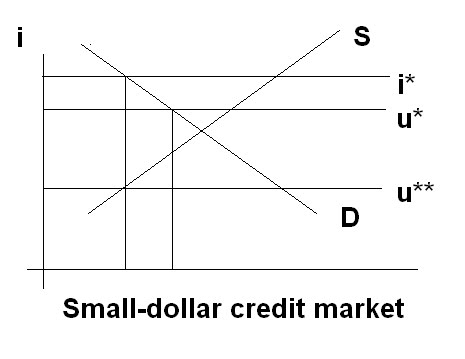
Does this sound implausible to people? Take a look at Table 4, on page 29 of the recent report on these small-dollar credit products that I recently co-authored. I was surprised to see this result myself, and although it's hard to know what to make of it it's indicative. We predict usage of these products, controlling for the amount of the price cap in force in the state, and we include a dummy variable (i.e. - a variable that equals zero or one) to indicate whether there was no cap. This allows the usage rate for people in states with no usury law to vary from the trend line estimated for states with a usury law (see the illustration below). What we found was that for payday loans and especially for auto title loans, usage rates declined when there were no usury restrictions at all! That's not supposed to happen in the Econ 101 model! It makes sense in this Keynesian model (and there are a few other credit rationing models - notably Stiglitz and Weiss (1981) - which also predict this behavior).
Now - it could be a few other things. We could be dealing with some endogeneity here. States without big small-dollar loan problems or markets might be less likely to implement laws. This could be an issue with the estimate, but (1.) we controlled for a lot of individual and state level variables that you traditionally think of as being associated with these issues, and (2.) if we did have some endogeneity on our hand, you would expect the coefficient on the price cap variable to be negative as well - we don't see that.
Several of our products didn't even have interest rate caps to speak of, and these are just two tenuous results - but it's interesting enough to see that that I think it's worth investigating further (and I hope to some day). There's more that can be done with the data we used, and there are some other data out there that could corroborate. The point is, at this point the story I told above is not a crazy story.
Where does that put us with usury laws? Well - outright bans of usury are still not a good idea, whether you're coming from this Keynesian model, the economics 101 model, or the Stiglitz and Weiss (1981) credit rationing model. But it says we shouldn't be too knee-jerk about some restrictions on interest rates, and it suggests that the old usury opponents in the early Church and even back to ancient times might not have been entirely crazy. Like the mercantilists who were grappling with a proto-monetary disequilibrium theory, the usury theorists were thinking more deeply about interest rates and the loanable funds market than a lot of people who just parrot the textbook model do. It doesn't make them right - but they were may have been "wrong for the right reasons".